To view photo images scroll right on laptop or down on Iphone
Ace’s November 2024 project, kinoownaa (to counsel somebody), is a new collaborative work with law, interdisciplinary students, faculty, including Indigenous participants, at the University of Quebec in Montreal (UQAM) and is an extension of his previous work undertaken in Canada, Switzerland, and France addressing the Truth and Reconciliation Commission (TRC) Calls to Action and United Nations Declaration on the Rights of Indigenous Peoples (UNDRIP). This on-going series of collaborations making art out of human rights standards is a “call to action” to heighten the domestic and international profile and urgency for the full implementation UNDRIP and alignment of federal and provincial laws by Canada, the Provinces and international Nation States.
For this project, Ace worked with students enrolled in the course Droit, peuples autochtones, et État canadien:
COURS //JUR6541 Droit, peuples autochtones, et État canadien
L’objectif général de ce cours vise à analyser le droit canadien encadrant les rapports entre l’État et les nations autochtones tant comme véhicule du colonialisme que comme outil de rééquilibrage, en vue d’amorcer une réflexion sur le rôle du droit et des juristes dans la (re)construction des relations entre les nations autochtones et les institutions de l’État.
Sommaire du contenu
Ce cours vise spécifiquement à exposer l’étudiant à une diversité de normes, notamment la Loi sur les Indiens, la partie II de la Loi constitutionnelle de 1982, la Convention de règlement relatives aux pensionnats autochtones et la Déclaration des Nations Unies sur les droits des peuples autochtones, tout en expliquant leur contexte d’émergence et d’application. Il introduit également l’étudiant aux ordres juridiques autochtones. Au terme de ce cours, l’étudiant saura comprendre et analyser ce champ du droit de manière critique et décloisonnée, ainsi qu’envisager son rôle à titre de juriste de façon éthique.

kinoownaa (to counsel somebody)
Kinoownaa (to counsel somebody) consists of a hand-built raku fired vessel created by Ace containing 46 partially and fully beaded floral motifs, hand-written vellum scrolls and tobacco ties for each of the articles of the United Nations Declaration on the Rights of Indigenous Peoples. These beaded medallions were created by workshop participants over two days at University of Quebec in Montreal (UQAM).
A partially opened circular circuit board lid is pierced by two phosphorescent tubes referencing lines of communication emanating from deep within the vessel containing the 46 partially and fully beaded medallions and 3 incomplete. The vessel is surrounded by reflective hexagon shapes that are most commonly found in honeycomb and in star blanket motifs. The hexagon is perceived as a symbol of harmony, balance, community, cooperation and hard work. Just like the hexagon that relies on its equal sides for stability, so too does the United Nations Declaration on the Rights of Indigenous Peoples for its global implementation.
Press:
UQAM – Alice Young. Souligner les droits des peuples autochtones, une perle à la fois
For information on Ace’s international and domestic collaborative work addressing human rights standards, see the following projects:
For additional reading:
Documents
United Nations: Declaration on the Rights of Indigenous Peoples
Province of British Columbia: Declaration on the Rights of Indigenous Peoples Act
Department of Justice (CANADA): Draft UNDA Action Plan
The artist acknowledges the generous support of Faculté de science politique et de droit de l’UQAM; Doris Farget, Professeure, Département des sciences juridiques de l’UQAM, Directrice du GRIAAC / CIÉRA-MTL; and NISKA (pour Étudiants autochtones), Bureau de l’inclusion et de la réussite étudiante (BIRÉ) (UQAM).
The artist also acknowledges the generous support of the Ontario Arts Council for the creation of the raku vessel through the funding of the Zhaabwaabndaan (to see through) project.
List of participants with UNDRIP Article Number:
-
-
-
-
-
-
- Louna Oukil
- Melodie Villeneuve
- Earl Truelove
- Naima Le Nédic
- Mila Mailhot
- Absentee
- Rebecca Dasy
- Absentee
- Marc-Andre Bourgault
- Jessy Jourdain
- Cloé Gravelle
- Loric Fortier
- Sophie Duval
- Alison Escobar
- Xiaohan Diao
- Ramanpreet Sharma
- Sylvestre Desterres
- Lea-Marie Tremblay
- Camille Rancourt
- Marlyse Revol
- Nicole Yurkevych
- Laetitia Mohamadi
- Barry Ace
- Jade Bellemare-Rivest
- Doris Farget
- Debora Bomolo
- Roxanne Comtois
- Caroline Chandonnet
- Mirja Trilsch
- Hortense-Femke Héon
- Alexis Robitaille-Duclos
- Absentee
- Helene Piquet
- Olivia Giordano
- Amélie Deschatelets
- Jeanne Boily
- Félixe Caron Boudrias
- Gabourg Amrita Kamala
- Pascale O’Bomsawin
- Lola Foubert
- Leila Lopez-Proulx
- Catherine Bussiére
- Lilou Chaigneau
- Frédérique Forest
- Jacques Papy
- Berenice Mollen Dupuis
-
-
-
-
-
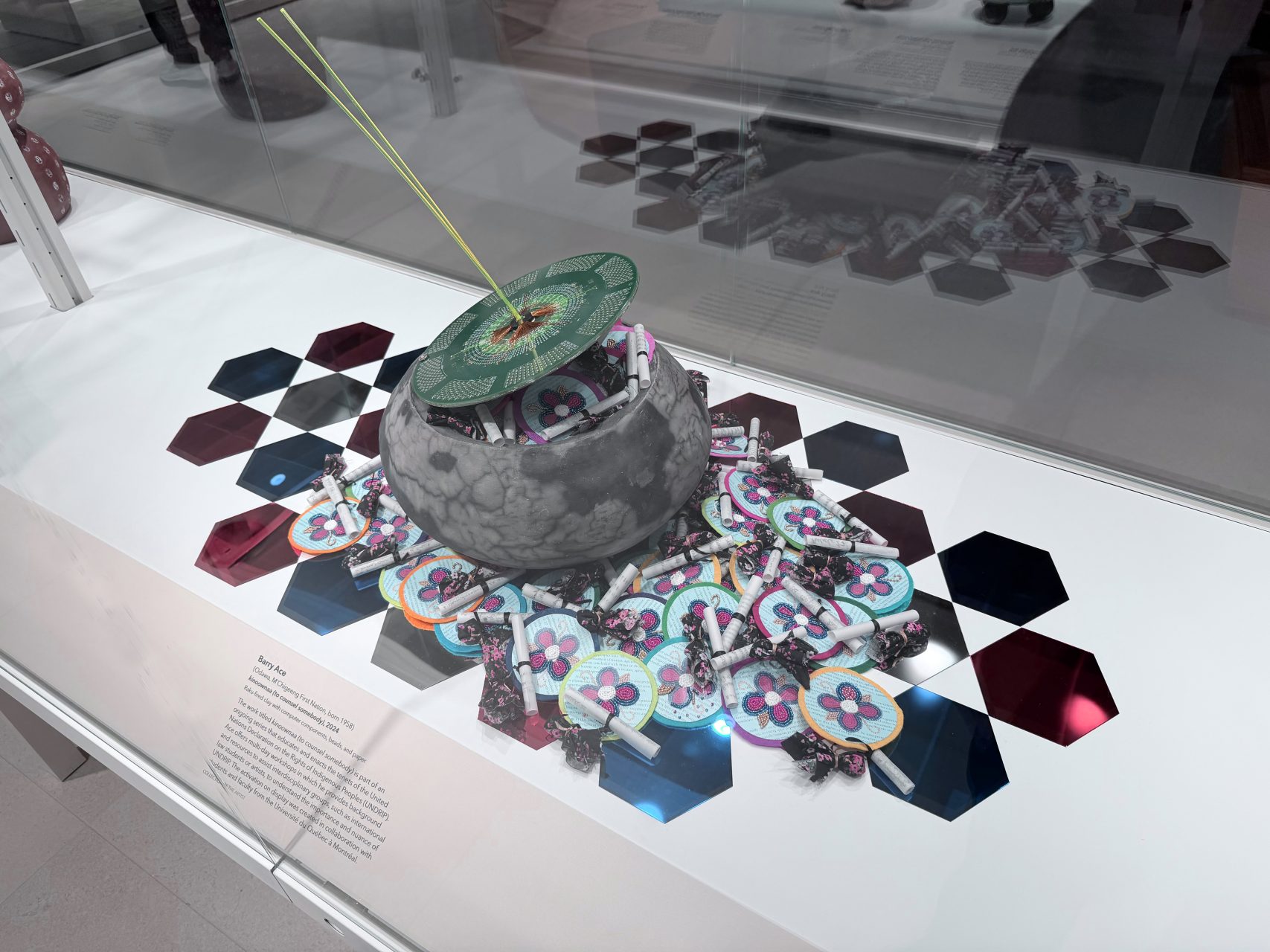 kinoownaa (to counsel somebody) (2024) 94 x 69 x 53 cm. Hand-built clay vessel (stone buffed and raku fired), circuit board, plastic, paper, glass-beads, vellum, graphite, tobacco, fabric, metal, copper, sinew. Collection of the Gardiner Museum (Toronto). The artist grateful acknowledges the support of the Ontario Arts Council for the creation of the vessel.
  L’Université du Québec à Montréal (UQAM)
 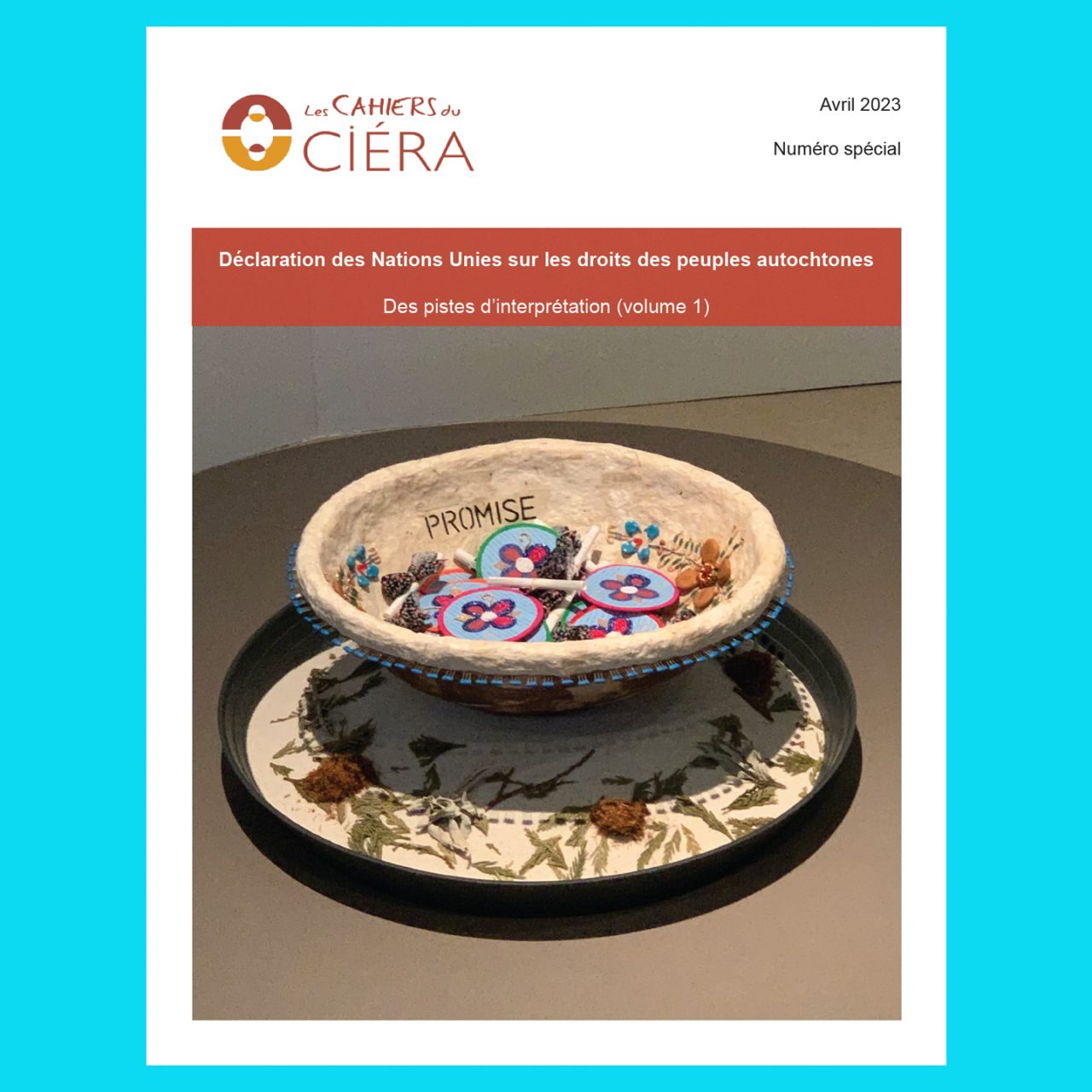 Les Cahiers du CIÉRA